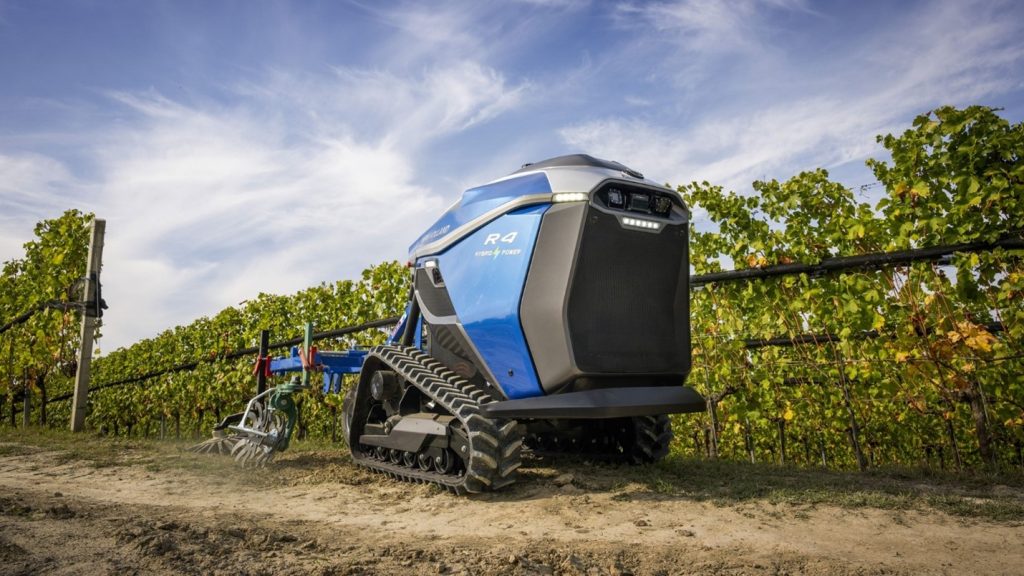
Buiilding from its heritage in diesel power, agricultural and industrial equipment manufacturer CNH Industrial has embraced clean-energy technology with permanent-magnet electric propulsion in two of its recent development efforts, especially for its New Holland brand. A stand-out innovation from the engineers is the new R4 robotic vehicle for working vineyards and orchards, another is a hybrid-electric telehandler for material handling that is in prototype stage.
“High-value crops have huge market potential, but growers face production challenges including skilled labour shortages for highly repetitive work during seasonal peaks,” says Thierry Le Briquer, Grape, Olive & Coffee Global Manager at New Holland, one of the CNH brands. “R4 robots have been developed to automate such jobs, boosting both efficiency and sustainability with a zero-emission solution.”
Engineers from the CNH R&D Centre in Modena, Italy and the New Holland Centre of Excellence for Specialty Harvesting in Coex, France, together with colleagues from around the world, set out to refocus skilled human input where it matters: in value added tasks. The resulting R4 robots execute repetitive, lower value tasks where accurate and safe work does not depend on human presence – jobs such as inter-row mowing or tillage. The two autonomous robots also address the most time-consuming tasks in vineyards and orchards – spraying, for example. Managed via an app, R4 machines are controlled via a combination of GPS, LIDAR and vision cameras.
“R4 is an all-new concept — there is no cab,” continues Le Briquer. “It has been designed fresh from the ground up, yet it is built entirely on our in-house foundation and using our expertise in electronics, powertrains, precision tech, and more. It’s the newest member of our product family, joining our lineup alongside tractors, grape harvesters and other machines.”
Both versions feature suspended rubber-track drive units to maximize traction and minimize compaction, and incorporate an intelligent, continuously-variable electric drivetrain. They can power implements electrically without hydraulic oil, reducing maintenance requirements, components, weight, emissions, cost and compaction. Both machines are compatible with existing implements.
Targeted primarily at high-end narrow vineyards, R4 Electric Power is electrically-powered via a 40kWh battery pack. With a 1.38m maximum height and overall width of just 0.7m, the R4 Electric Power can work in 1.0-1.5m crop spacings and weighs just one ton. A custom-designed, ultra-compact hitch has a 500kg lift capacity, and the machine can also power electrically- driven implements.
The bigger full-hybrid model, R4 Hybrid Power, is designed for orchards and fruit producers and offers more power and extended autonomy, with a power-to-weight ratio double that of a conventional specialty tractor with similar output. Weighing 1,400kg and measuring 1.2m wide, the machine is optimized for row spacings of 1.5m and above. Its double-pass capability ensures complete coverage, allowing it to operate efficiently in large orchards without misses.
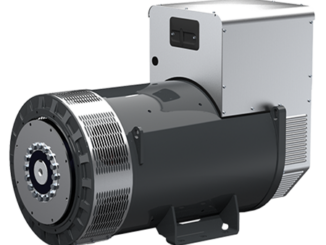
Power is provided by a 59hp/44kW diesel engine which can run on vegetable oil-based fuels to cut emissions. This drives an electric generator pack for transmission and implement power. When suitable, R4 Hybrid Power can run in fully-electric mode, with the two 4kWh batteries powering the machine for zero-emission and quiet operation. The electrically-powered is basically maintenance-free. A mechanical 540rpm PTO with intelligent progressive clutching works with standard implements and a 48V/12kW e-PTO socket can power future electrically-driven machines.
Hybrid prototype telehandler offers practical, sustainable power
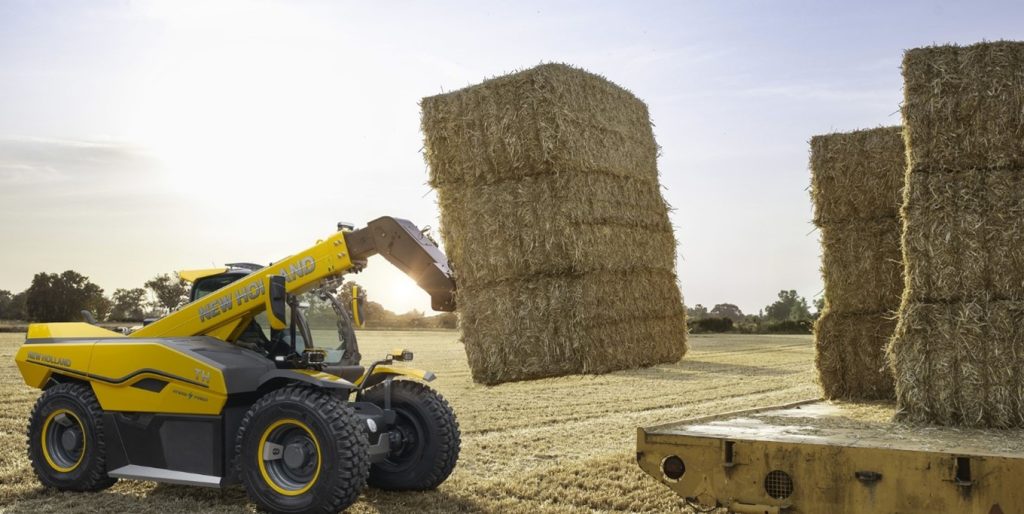
New Holland also recently unveiled a hybrid full-size telehandler prototype that redefines practicality in alternative-fuel farm equipment. It combines the autonomy and power farmers value without the run-time limitations of battery-only machines or the reliance on fossil-fuels of diesel models.
Currently in testing phase, the machine features an electric drivetrain connected to a supplementary battery/electric power system. It operates fully electrically for up to four hours on medium-heavy tasks and up to six hours on light-duty cycles. During heavy-duty work, a four-cylinder F28 methane gas engine from FPT provides supplementary power and simultaneously recharges the battery.
The 2.8-litre engine generates 75kW/100hp and operates at a fixed speed to minimize fuel consumption while maintaining performance, helping to extend service intervals and maximize efficiency. There is 84kW/112hp rated output available at the hydraulic pump and 115kW/154hp rated available for traction. A 70kWh battery provides electrical power in both hybrid – when the engine speed is maintained at its most efficient working point – and full electric modes.
Field tests showed up to 70% saving in energy usage compared to diesel alternatives, and 30% better performance, efficiency and autonomy than a comparable diesel-powered vehicle during typical material handling operations. The electric powertrain also improves productivity since traction control operates independently from attachment control.
“With this prototype, New Holland shows its continuous commitment to the “Clean Energy Leader” strategy, building on our leadership in alternative fuel machines,” says Marco Gerbi, New Holland T4 and T5 Tractor, Loader & Telehandler Product Management.
T4 technology helped forge the path
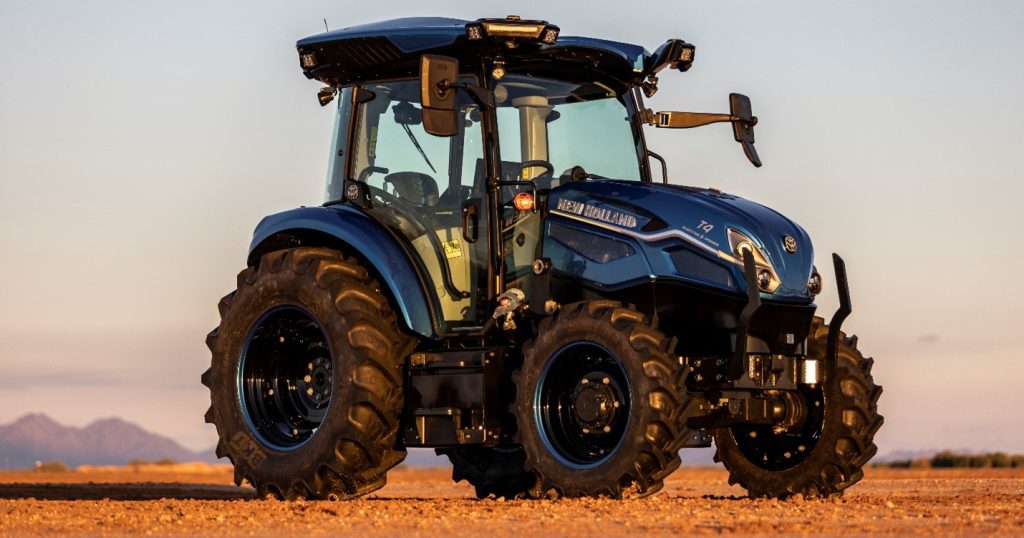
Inspired by the development of their T4 electric power utility tractor, CNH engineers generally design their electric drivetrains using low-speed, high-torque permanent magnet synchronous motors. The T4 electric power motor, for example, provides up to 120 horsepower (89 kW) and 440 Nm of torque, thus harnessing the energy of electricity with the characteristic torque of electric motors. See www.cnh.com and www.newholland.com.