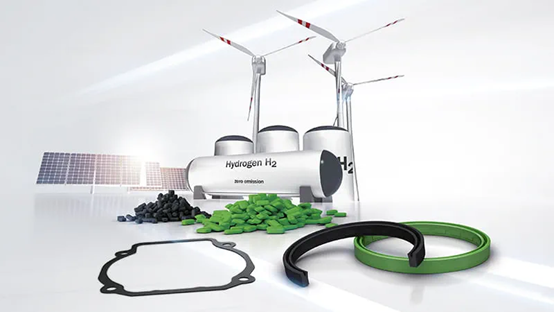
Trelleborg Sealing Solutions continues to build its portfolio of materials and products for the hydrogen value chain, as evidenced by its showings at Hydrogen Technology Expo 2025 in October at Hamburg. Scientists and product developers at the company are expanding its H2Pro range of 20-plus materials for applications in the production, transport and storage and end-use of hydrogen, including its FlexiBond solution, designed for use in electrolyzers and fuel cells.
“Our comprehensive range of more than 20 H2Pro materials, proven in our proprietary testing regimes to meet the requirements of real-world hydrogen applications, are now available for customers across the hydrogen value chain, “ says James Simpson, Global Segment Director Energy.
Flexibond, one of the latest innovations in the H2Pro portfolio, enables new design possibilities for electrolyzers and fuel cells by combining the capabilities of large frame seals with a high-stability shape, and reduces the level of investment needed for complex injection molding equipment, he notes.
https://www.trelleborg.com/en/seals/your-industry/hydrogen-sealingH2Pro materials provide specialized sealing solutions in challenging hydrogen environments including high pressures and low temperatures, and are characterized by minimal hydrogen permeation, resistance to rapid gas decompression and effective abrasion and extrusion properties. The materials can be used to create engineered molded parts including frame seals, rubber-to-metal and rubber-to-plastic components.
Advanced testing and R&D capabilities are another focus, recently enhanced by a new 93 sq meter/1,000 sq feet hydrogen test facility in Fort Wayne, Indiana. Capabilities there include hydrogen leak detection, compatibility, dynamic testing and permeation testing, which are all critical criteria for sealing hydrogen. Engineering experts perform tests that replicate worst-case application conditions for rapid gas decompression. In a high-pressure system, hydrogen can be absorbed into a seal and if the pressure is suddenly relieved, gas trapped in the seal can expand, potentially causing the seal to blister and crack as the gas tries to escape. There are also testing capabilities for pressures up to 1,500 bar/15,000 psi and across all temperature ranges from cryogenic to above 180 °C/350 °F, and environmental thermal cycle testing at various pressure profiles. For more info, see www.trelleborg.com.