Oracle has expanded its plans to procure Bloom Energy fuel cells to support the rapid buildout of its AI and cloud computing infrastructure. Under a master services agreement, Oracle intends to procure up to 2.8 gigawatts of Bloom’s fuel cell systems, upping the previously contracted 1.2 GW of capacity. The move brings validation to Bloom Energy’s research about future growing demands by the data center market to go off-grid for critical power.
The expanded partnership underscores Bloom’s capability to provide fast, reliable power suited for AI workloads, which require rapid, load‑following support that traditional grids were not designed to deliver. Bloom’s systems are built to support higher-density AI workloads more efficiently, with a technology platform aligned to emerging standards such as 800 V dc.
“By rapidly deploying Bloom’s reliable, efficient fuel cell energy, we are quickly meeting the demands of our customers across the United States,” said Mahesh Thiagarajan, executive vice president, Oracle Cloud Infrastructure. “Together, Bloom and Oracle Cloud Infrastructure are building the power foundation and AI infrastructure to accelerate American AI leadership.”
This agreement builds on the companies’ existing partnership and reflects a broader shift toward distributed, onsite generation as a critical component of modern digital infrastructure. Bloom’s modular fuel cell systems can be deployed far faster than traditional power solutions, enabling customers to accelerate time‑to‑power and reduce project risk. Last year, Bloom Energy delivered a fully operational fuel cell system to Oracle in just 55 days—more than a month ahead of the anticipated 90‑day deployment schedule.
“We are delighted to expand our relationship with Oracle following an initial successful deployment,” said Aman Joshi, Chief Commercial Officer at Bloom Energy. “Together, we are defining a shared vision for the future of energy and AI infrastructure, with Bloom advancing its position as the standard for onsite power.”
Data centers plan to reduce reliance on grid
In January, Bloom released its latest Data Center Power Report which surveyed decision-makers across the data center power ecosystem. The survey found that more data center leaders are reducing their reliance on utility grids by investing in onsite power for rapidly scaling data centers. The report also revealed that power availability is driving data center development decisions as the industry moves into a new set of power-friendly regions. Together, these findings suggest a significant structural market shift for “AI factories” and other high-density data centers.
The report’s findings indicate that:
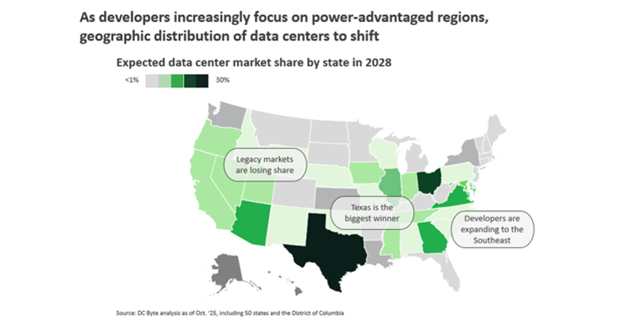
- Power availability is creating new geographic winners and losers: Texas is poised to capture nearly 30% of U.S. data center market share by 2028 and Georgia’s market share is expected to grow by 75% (from 4% of the total data center market to 7%) as developers expand deeper into the Southeast. In contrast, California, Oregon, Iowa, and Nebraska’s respective relative market shares are expected to drop by more than 50%.
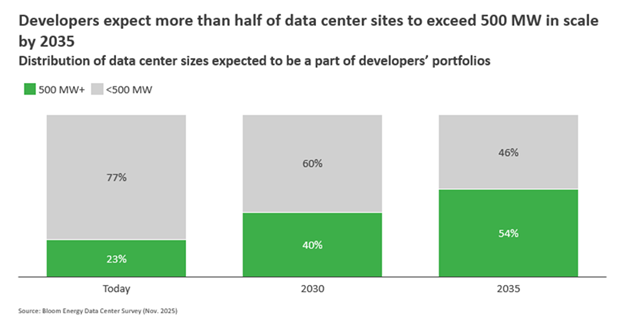
- More data centers are approaching gigawatt scale: Over 50% of new data center campuses are predicted to exceed 500 MW by 2035 and nearly one-third of new data center campuses to exceed 1 GW, with each 1 GW campus consuming roughly as much electricity as the entirety of San Francisco.
- The power expectation gap is widening in key hubs: Utilities project delivery timelines are approximately 1.5-2 years longer than hyperscalers and colocation providers expect. Over the past six months, the expectation gap has widened in three critical hubs – Northern Virginia, the Bay Area, and Atlanta.
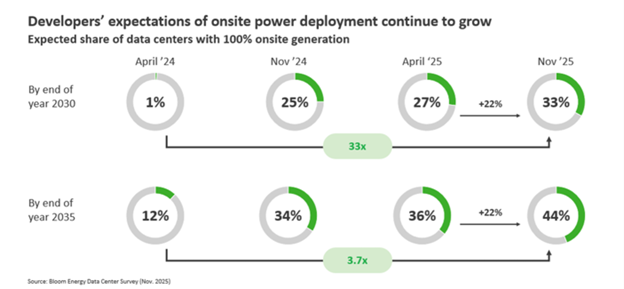
- Data center developers plan to make big bets in off-grid power: Hyperscalers and colocation providers expect that roughly one-third of data centers in 2030 will use 100% onsite power, a 22% increase from the previous report six months ago. Developers surveyed believe that, by 2030, onsite power will be a leading solution to minimizing development timelines and costs.
- Higher‑voltage and DC electrical architectures are moving from roadmap to reality. As AI campuses scale to gigawatts, operators are redesigning power systems to handle denser loads and faster build schedules. 45% of respondents expect to adopt direct‑current (DC) distribution architectures in their new data centers by 2028. These designs are likely to be incorporated into data centers entering development this year.
“Data center and AI factory developers can’t afford delays. Our analysis and survey results show that they’re moving into power‑advantaged regions where capacity can be secured faster—and increasingly designing campuses to operate independently of the grid,” said Natalie Sunderland, Bloom Energy’s Chief Marketing Officer. “The surge in AI demand creates a clear opportunity for states that can adapt to support large-scale AI deployments at speed.”
For more info, see www.bloomenergy.com. You can download a copy of the report here.