Led by Sandia National Laboratories and supported by a group of collaborators, the concept of generating energy using permanent magnet turbines in tidal flows is moving toward fresh validation on the Piscataqua River in Portsmouth, New Hampshire.
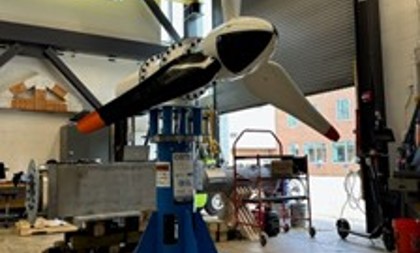
Sandia announced in July the successful assembly of the U.S. Department of Energy’s instrumented open-source tidal energy converter (OSTEC) reference turbine system by project partner the Atlantic Marine Energy Center (AMEC) at the University of New Hampshire. The turbine is currently at the university’s research pier to complete sensor and instrumentation checks prior to installation on the turbine deployment platform at the center’s tidal energy site.
The multi-lab collaboration is led by Sandia alongside UNH as the primary research partner. The project also has received significant contributions from the National Laboratory of the Rockies which designed the data acquisition system known as Modular Ocean Data Acquisition (MODAQ), and the Pacific Northwest National Laboratory which collaborated on the turbine conceptual design and specified the power take-off, grid interconnection, and control system. The setup utilizes a Siemens SIMOTICS permanent magnet servo drive and generator rated at 26.2 kW.
As a fully instrumented tidal energy test bed, the OSTEC turbine system is poised to become a key enabler of significant research and development for tidal energy over the next 10 to 15 years. With over 50 sensors, it is designed to collect over 1,000 different measurement data streams and archive a terabyte of data every hour of testing. Planned studies include investigating the effects of turbulence on turbine load response, validating turbine design and analysis modeling tools, and testing turbine components and materials, e.g., blades, structural health monitoring sensors, and eco-friendly lubricants in gearboxes.
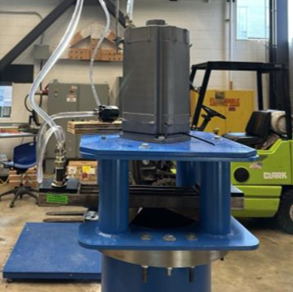
The University of New Hampshire and AMEC has been leading the design and fabrication of the power take-off — drive train transferring mechanical power from rotor to the motor-generator, nacelle — power-take-off housing aft of the rotor, and tower and yaw assembly, as well as upgrades to the test platform. PNNL focused on the design of the PTO, selecting commercial off-the-shelf gearboxes, generators and power electronics, and conducted an analysis to inform the turbine’s water-cooling system.
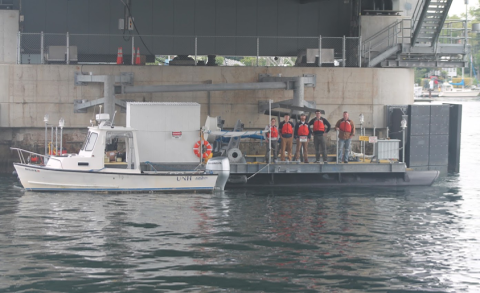
The test site is at the marine center’s Living Bridge Project where the Memorial Bridge has been converted into a demonstration “smart bridge” for infrastructure studies The bridge has been outfitted with structural health monitoring sensors as well as environmental sensors on its structural elements and in the river. Beneath the bridge, the tidal turbine is designed to power these sensors and offset energy usage on the bridge, as well as to demonstrate tidal flow as an emerging renewable energy technology. For more info, see www.sandia.gov and www.unh.edu.